Spray Foam vs. Blown-In Insulation — Which Is Right for Your North Texas Home?
Typical cost: The comparison is free — and if blown-in is the better buy for your attic, we will tell you so
Search for an insulation company around Anna and you will meet two very different products wearing the same word. Blown-in insulation (loose-fill fiberglass or cellulose) is a thermal blanket: a machine fluffs it across your attic floor, it slows heat flow, and it is the most affordable way to add R-value to an attic that just needs more. Spray foam is a different animal: it expands into every gap and cures in place, insulating and air-sealing in the same pass — which matters enormously in a climate where the attic above your ceiling can exceed 140 degrees in July.
We are a spray foam company, and we will be straight with you about what that means: foam is the premium product and the premium price, and it is genuinely the wrong answer for some projects. This page is the honest version of the comparison — the one we walk through at every free inspection — so you can judge any quote you get, including ours.
The shortest version: blown-in wins on price for simple attic top-ups over clean, dry existing insulation. Foam wins everywhere air leakage, moisture or geometry is part of the problem — roof decks, walls, metal buildings, new construction, and attics being brought inside the conditioned envelope. Most of the corridor's best insulation jobs use the right tool in the right place, not one tool everywhere.
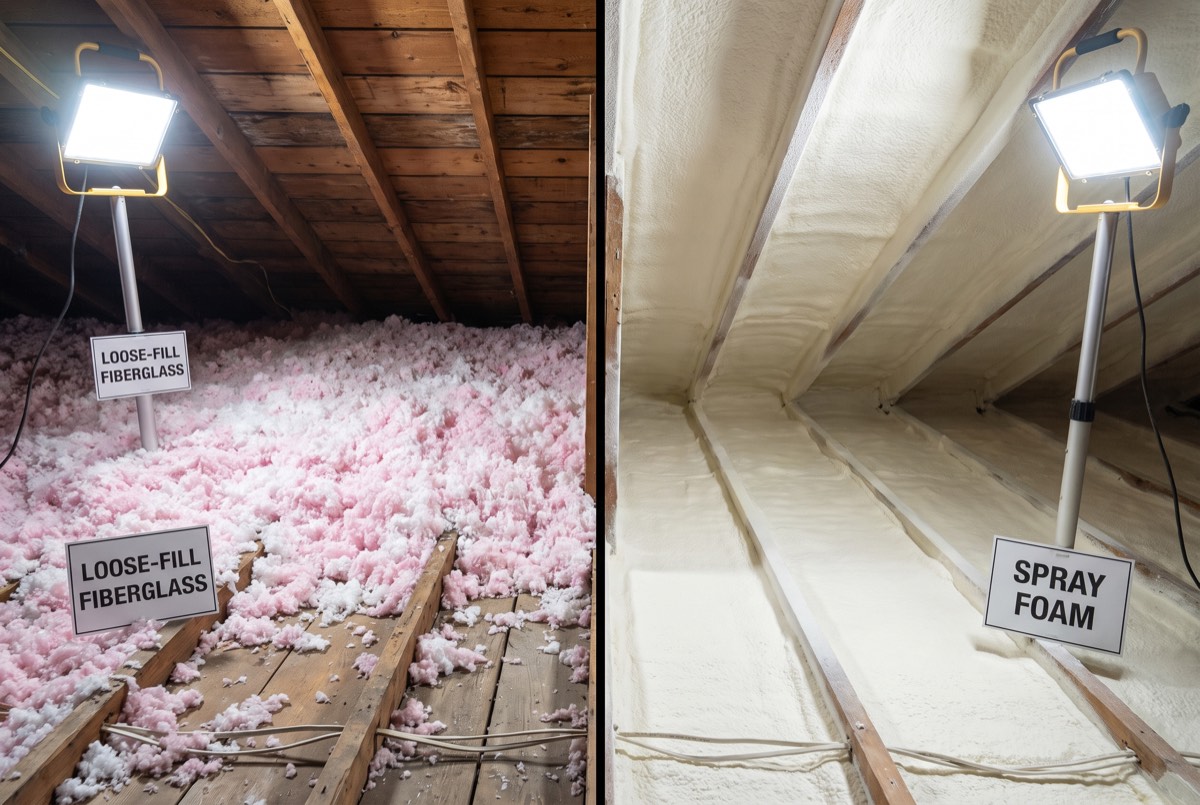
Two different tools: a thermal blanket on the floor, or an air-sealed envelope at the deck.
What is included
- Blown-in loose fill: roughly $1 – $2 per square foot for most attic top-ups
- Open-cell spray foam: roughly $0.45 – $0.75 per board foot (a square foot at one inch)
- Closed-cell spray foam: roughly $1.00 – $1.60 per board foot — plus built-in moisture control
- R-value per inch: blown-in ≈ R-2.5–3.7, open cell ≈ R-3.5–3.8, closed cell ≈ R-6–7
- Air sealing: foam yes, blown-in no — the difference Texas summers expose
The numbers, side by side
R-value per inch: blown-in fiberglass and cellulose land around R-2.5 to R-3.7 per inch; open-cell foam about R-3.5 to R-3.8; closed-cell foam R-6 to R-7 — roughly double anything else per inch, with a built-in vapor retarder. Cost: a typical blown-in attic top-up runs about $1 to $2 per square foot installed; open-cell foam about $0.45 to $0.75 per board foot; closed cell $1.00 to $1.60 per board foot. On a plain attic floor, blown-in is usually the cheaper path to the zone-3 target of R-38. On a roof deck, in walls, or against steel, foam is usually the only path that actually works.
Air sealing — the part the R-value chart leaves out
Insulation slows heat moving through materials. It does nothing about the conditioned air leaking out through the hundreds of penetrations in a typical ceiling — can lights, top plates, duct boots, the attic hatch. ENERGY STAR's methodology credits air sealing plus insulation together with an average of about 15 percent off heating and cooling costs, and the sealing half of that is the half blown-in cannot touch. Foam does both in one pass. A hybrid approach — hand-sealing the ceiling penetrations, then blowing loose fill over the top — is the budget middle path, and a good one for simple attics.
When blown-in honestly wins
Your existing attic insulation is clean, dry, rodent-free and simply thin; your ceiling plane is reasonably tight; your ducts are in decent shape; and the attic will stay a vented attic. In that house, topping up to R-38 with blown-in is the best dollar in insulation, and a company that quotes you foam without mentioning it is selling, not advising. Utility incentive programs in Oncor territory have also historically favored exactly this upgrade — ask at the inspection and we will tell you what currently applies and who can apply it.
When spray foam is worth the premium
Roof-deck retrofits that bring the attic inside the envelope (the fix for the upstairs-never-cools house and for ducts baking in attic heat). Walls, where loose fill cannot reach. New construction, where foaming the envelope lets the HVAC be sized smaller from day one. Metal buildings and barndominiums, where condensation makes closed cell the only serious answer. And any assembly where inches are scarce and every one has to count.
The free way to settle it
Every quote we do starts with a real look at the attic — what is up there, how thick, what condition, where the air is leaking. You get the honest map: foam here, blown-in there, or no sale at all if your insulation is already doing its job. Call (469) 526-2028 and get the comparison done on your actual house instead of a brochure.
Serving Anna, Melissa, Princeton, Van Alstyne, Weston and nearby
This service is available across our full coverage area. See the service area map for the complete list, or call (469) 526-2028 to check a specific address.